
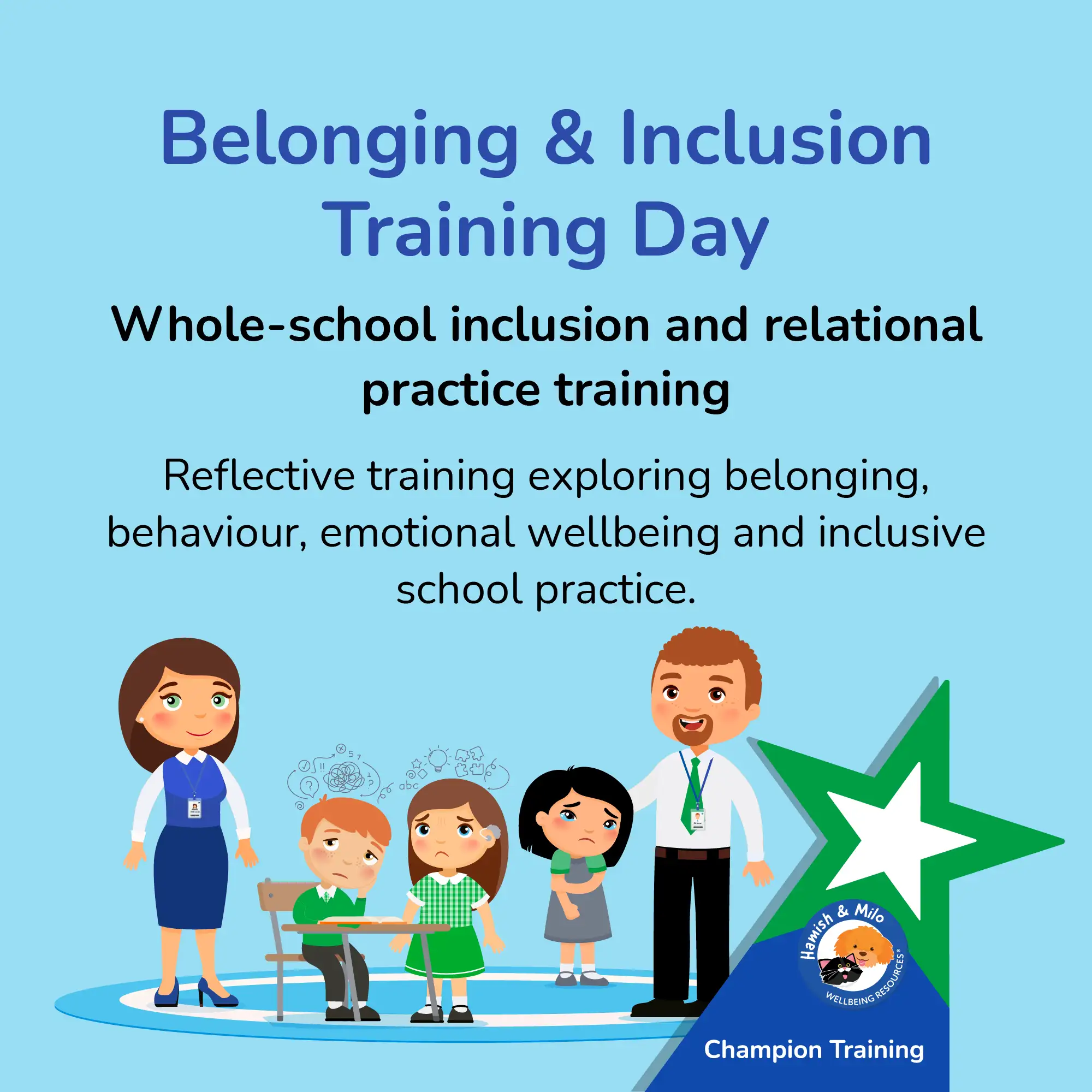
Belonging and Inclusion – one day training course overview

Understanding social and emotional behaviour and developing practice that makes a difference for every child.

In today’s increasingly complex school environments, fostering a genuine sense of belonging is essential for children’s wellbeing, engagement and achievement. At the same time, behaviour is often misunderstood, viewed in isolation rather than as communication shaped by developmental, emotional and environmental factors.

This one-day training course brings together inclusion, behaviour and social-emotional development. It supports staff to understand behaviour through a relational and trauma-informed lens, while also recognising the importance of explicitly teaching social and emotional skills and providing targeted intervention for pupils who need additional support.

Participants will develop the confidence to move beyond reactive approaches, towards a model that combines universal inclusive practice, targeted support, and relational responses ensuring every child feels safe, understood and able to succeed.
This training will explore:

1. Understanding behaviour as communication

  • The developmental and neurological roots of behaviour.

  • Behaviour as an expression of unmet needs, stress responses or skill gaps.

  • Recognising signs of dysregulation, anxiety, shutdown and overwhelm.

  • Using a relational, trauma-informed lens to interpret behaviour.

2. Belonging, inclusion and the impact on behaviour

  • The psychology of belonging and its link to behaviour, motivation and learning.

  • How identity, representation and inclusion shape emotional safety.

  • The impact of exclusion (subtle and overt) on behaviour and engagement.

  • Creating environments where all children feel seen, valued and connected.

3. Explicit teaching of social and emotional skills

  • Understanding behaviour as a skills gap, not just as chosen behaviours.
  • Key areas of social and emotional learning (SEL):

    • Self-awareness
    • Self-regulation
    • Social skills
    • Emotional literacy
    • Problem-solving and resilience
  • Practical strategies for embedding SEL into everyday teaching.
  • Using modelling, scaffolding and rehearsal to build children’s skills.

  • Integrating SEL into routines, curriculum and interactions.

4. Responding to behaviour: relational and needs-led approaches

  • Responding with curiosity and an informed relational approach.

  • Co-regulation and adult presence as the foundation for emotional safety and belonging.

  • De-escalation strategies and supporting children in moments of overwhelm.

  • Creating emotionally predictable environments that reduce triggers.

  • The role of language, tone and consistency in behaviour support.

5. Targeted intervention and responsive provision

  • Identifying pupils who need additional support beyond universal provision.

  • Using observation and assessment to understand underlying needs.

  • Designing and implementing targeted interventions for:

    • Emotional regulation
    • Social interaction
    • Anxiety and withdrawal
    • Behaviour linked to trauma or unmet attachment needs
  • Structuring small group or 1:1 support effectively.

  • Monitoring impact and adapting provision.

6. Working in partnership

  • Building consistent approaches with parents and carers.

  • Supporting families to understand behaviour and emotional development.

  • Collaborating with wider professionals for joined-up support.

  • Creating a shared language and ethos of belonging across the school.

Outcomes for participants

By the end of the day, staff will:

  • Understand behaviour as communication and as an indicator of unmet needs or undeveloped skills.

  • Feel confident in both responding to behaviour in the moment and teaching the skills that enable social and emotional development.

  • Be equipped with practical strategies to embed social and emotional learning across the school day.

  • Know how to identify and support pupils who need targeted intervention.

  • Create more inclusive, predictable environments where all children can regulate, engage and thrive.