
SEND Reform 2026: What it means for mainstream schools

What does the SEND White Paper mean in practice for schools – supporting inclusion, belonging and meaningful outcomes for every child.

The UK Government has released its long-awaited Schools White Paper, Every Child Achieving and Thriving alongside the SEND Reform consultation: Putting Children and Young People First. It sets out proposed reforms aimed at strengthening mainstream inclusion, introducing greater national consistency, and increasing accountability across the Special Educational Needs and Disabilities (SEND) system. For schools, it signals a significant shift in SEND provision, EHCP reform and inclusion policy.

Together, the 2023 Improvement Plan and 2026 Schools White Paper represent the most significant shift in the SEND system since the Children and Families Act 2014. It reflects a shift from a reactive, diagnosis-led system towards earlier intervention, strengthened mainstream inclusion and greater national consistency.

Plans include a clearer tiered model of support, Individual Support Plans (ISPs), and new national expectations for what mainstream schools should provide. Here we break down the key elements of the proposed SEND reform and what it means in practice for schools including:

While the direction of SEND reform is clear, many elements remain in consultation, and the detail of implementation will continue to evolve.

For mainstream schools, this is not just policy change, it is a shift in expectations around inclusion, accountability and how to support children with additional needs.

The current landscape – and rising prevalence of SEND

There has been a significant increase in children with SEND over the past decade, rising far faster than overall pupil numbers. Since 2016, the total pupil population has grown by 5.5%, but the number of pupils with an Education, Health and Care Plan (EHCP) has doubled, while the number receiving SEN support without an EHCP has increased by 29.5%. Over half (51.6%) of pupils not meeting Key Stage 2 expectations in reading, writing and maths are identified as having SEND, highlighting the close link between learning, wellbeing and unmet need.¹

Key pressures shaping the SEND system
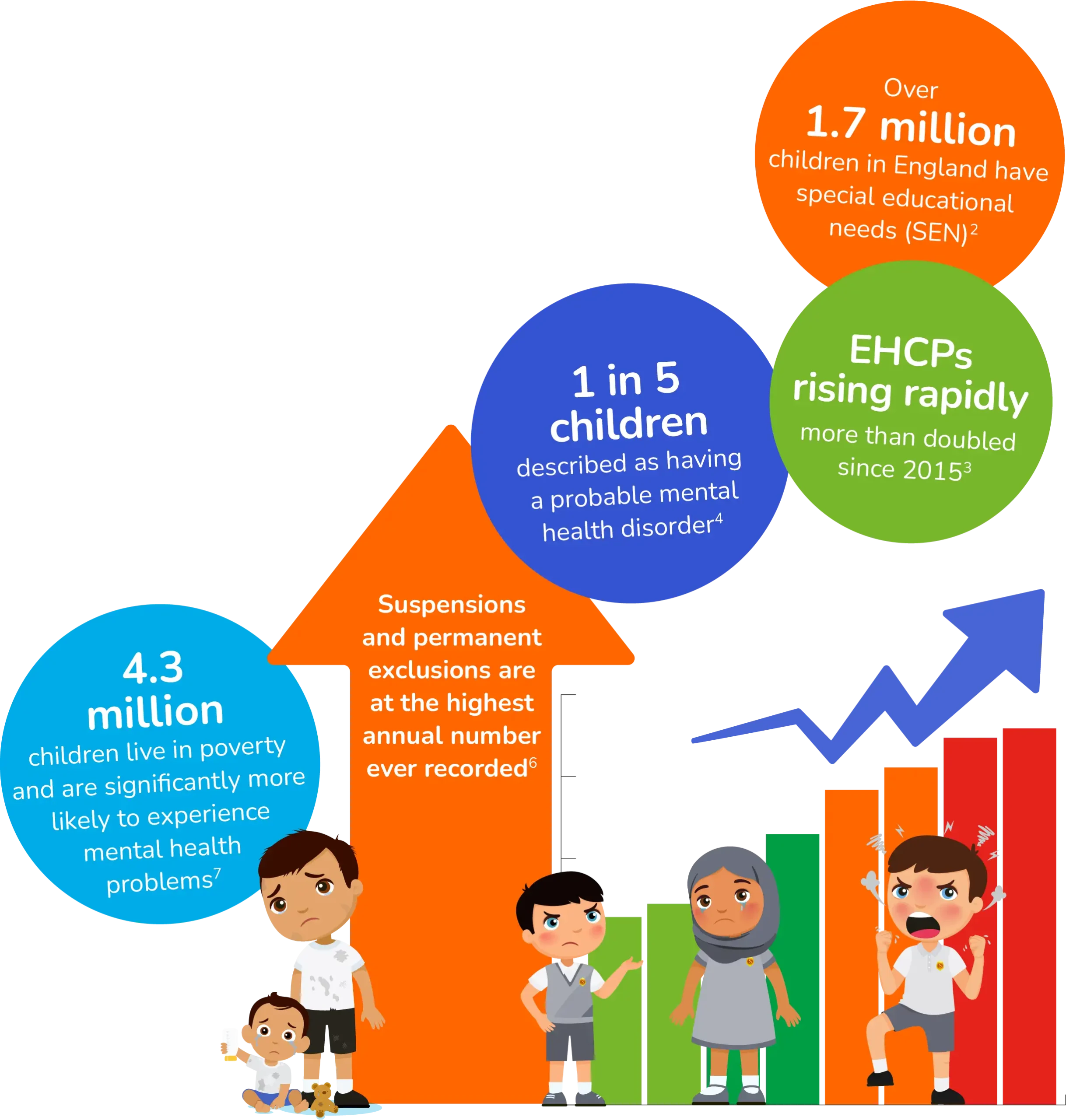
  • Over 1.7 million pupils in England are identified as having SEND, around 18% of all pupils (2024/25). ²

  • EHCPs rising rapidly – 5.3% of pupils have an EHCP, and those with SEN support has increased to 14.2% ³
    Primary schools have seen the largest increase in EHCPs, with an additional 21,000 pupils since 2024.
  • 1 in 5 children described as having a probable mental health disorder – NHS Digital data indicates a notable increase from one in ten children in 2004 to one in five in 2023. ⁴
  • Suspensions and permanent exclusions are at the highest annual number ever recorded ⁶ – a significant 24% increase for primary pupils.
  • 4.3 million children live in poverty and are significantly more likely to experience mental health problems. ⁷
  • Rates of persistent absence, often linked to Emotionally Based School Avoidance (EBSA), have more than doubled since 2018–19 – closely linked to anxiety, mental health needs and unmet SEND, with limited support currently available to support reintegration. ⁸
  • Adverse Childhood Experiences (ACEs) are common, with around 1 in 10 children experiencing four or more – including poverty, domestic violence and social care involvement, all strongly associated with SEMH, SEND and school non-attendance.

  • Over 40,000 children are waiting two years or more for supportChild and Young People’s Mental Health Services (CYPMHS) are under severe strain, local authority SEND budgets are significantly overspent in many areas and schools face increasing expectations without proportional funding.

Schools White Paper SEND Current Landscape with Data

Many of the children presenting with SEND and SEMH needs have experienced trauma or adversity, with ACEs now recognised as a significant underlying driver of need across education.

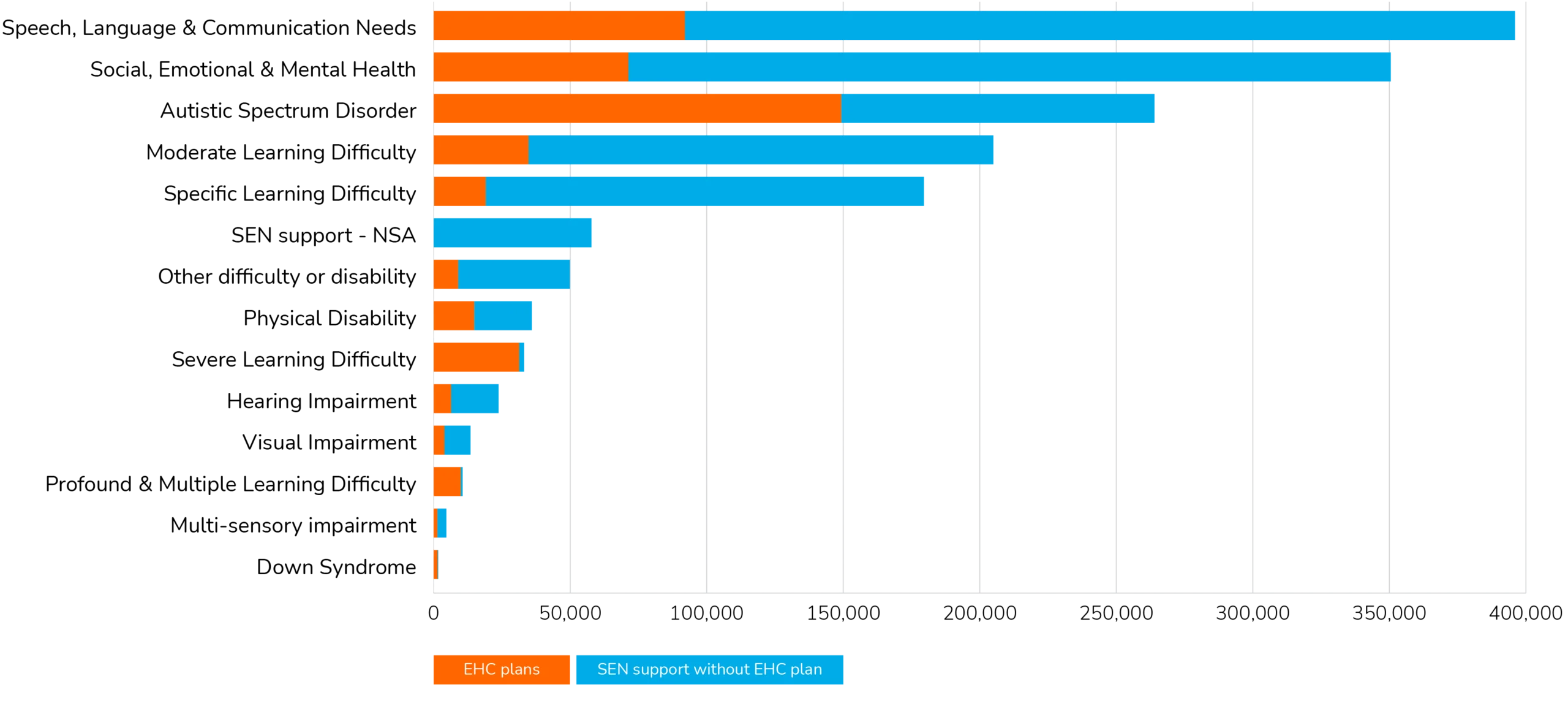
SEMH is one of the most significant and fastest-growing areas of need within SEND

Number of pupils with an EHC plan or SEN support, by type of need 2024/25

What schools are seeing

  • SEMH is now the second most common primary need for pupils with both an EHC plan and those receiving SEN support
  • Rising levels of anxiety, dysregulation and trauma-related need, leading to EBSA and increasing attendance challenges
  • Increasing demand on schools to meet needs as specialist services (CAMHS) are under significant strain, with long waits and many children not meeting thresholds for support

What this means in practice for schools

  • A whole-school understanding of behaviour as communication, particularly in response to SEMH needs

  • Emotionally attuned, relational approaches, supporting regulation, safety and connection
  • Structured, evidence-based interventions, delivered consistently to support emotional development and engagement

What current government’s SEND reforms are trying to achieve

Plans set out a shift towards earlier intervention, stronger mainstream inclusion, and greater national consistency in SEND provision.

The White Paper and the SEND consultation emphasise the need for a coherent national system and schools are expected to become more inclusive by design. Aims include:

  • Inclusion in mainstream as the norm
  • Earlier identification and support
  • Stronger support within schools before statutory escalation
  • Higher expectations for attendance, belonging and engagement
  • Closer collaboration between schools, families and wider health and care services

Under the proposed reforms children’s needs will be met through a new layered system of support. These changes sit alongside a strengthened universal offer, setting a new baseline expectation for inclusive practice for all children.
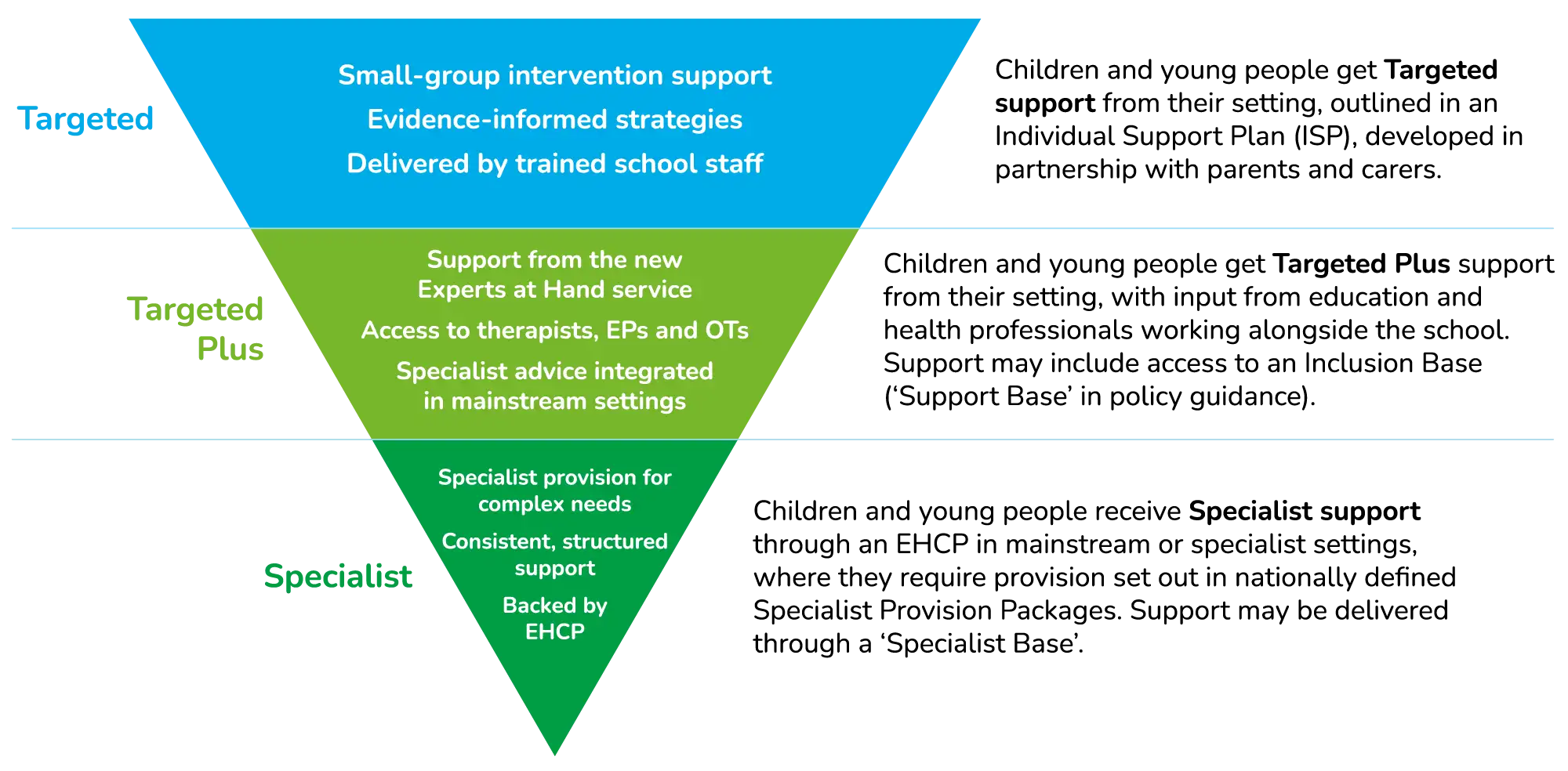
There are three layers of support above the Universal offer – Targeted, Targeted Plus and Specialist

SEND 2026 tiered model of support

The universal offer

The universal offer in SEND reform

At the centre of SEND reform vision is a strengthened universal offer, which sets out the support that should be available to all pupils, without the need for escalation to specialist services. This reflects a shift towards a more inclusive, preventative system, where needs are identified early and supported through everyday classroom practice.

Schools are expected to embed inclusion as a core part of how they operate. This includes:

  • Embedding inclusion within whole-school planning and decision-making
  • Using evidence-based interventions and approaches to support learning and wellbeing

  • Creating safe, predictable and respectful environments for all pupils
  • Developing strong partnerships with families and external services
  • Ensuring classrooms and school environments are calm, inclusive and accessible

The universal offer in practice

The universal offer is underpinned by high-quality relationship-based teaching, and a curriculum designed and developed to engage all pupils, with the expectation that many pupils’ needs can be met through strong classroom practice. In practice, this includes:

  • Adaptive teaching strategies that respond to a range of learning needs within the classroom
  • Reasonable adjustments to support access to learning and participation
  • Access to pastoral and wellbeing support

  • Staff trained to recognise emerging needs and early signs of SEND and mental health difficulties

  • Explicit teaching of social and emotional skills, helping pupils develop regulation, resilience, relationships and readiness to learn
  • Whole-school approaches to inclusion, ensuring consistency across leadership, staff and classrooms

Aligns with the graduated approach, where support begins at universal level before moving to more targeted or specialist provision where needed.

Targeted support

Targeted support within SEND reform

Targeted support will sit between the universal offer and specialist provision, providing more structured and focused support for pupils whose needs cannot be met through classroom practice alone.

It is typically delivered at SEND Support level, using the four-stage graduated approach (Assess, Plan, Do, Review) to identify need, implement support and monitor impact as their strengths and needs develop and change.

The intention is that many pupils can be effectively supported at this stage, reducing the need for escalation. Targeted support is about early, structured intervention, ensuring that pupils receive the right support at the right time before needs become more complex.

What targeted support looks like in practice

  • Small group interventions to support specific needs, such as literacy, numeracy, social skills or emotional regulation

  • Short-term, evidence-based programmes designed to address emerging needs early
  • Additional adult support, where appropriate, to scaffold learning and engagement
  • Develop new Individual Support Plans (ISPs) collaboratively with families, with clearly defined outcomes and regular review

  • Pastoral and SEMH support, particularly for pupils experiencing anxiety or EBSA
  • Regular review and adaptation of support, using the graduated approach to track progress and respond to need

This is a crucial part of a more preventative, inclusive SEND system, bridging the gap between universal provision and specialist support.

Targeted Plus support

Targeted Plus within SEND reform

Targeted Plus will sit between targeted support and specialist provision, providing extra support for pupils with more complex or persistent needs not fully met through SEND Support.

Targeted Plus is a key part of a more graduated and responsive system, ensuring that support can be increased in a timely and proportionate way, and pupils will move flexibly between layers based on need.

Targeted Plus is likely to involve greater input from specialists, more structured planning, and closer monitoring of progress. The intention is that pupils receive coordinated, multi-agency support at an earlier stage, reducing escalation but may not need an EHCP.

Reforms signal increased use of inclusion bases as part of a more flexible continuum of support within mainstream schools and settings.

What Targeted Plus looks like in practice

  • More intensive, structured interventions, often delivered over longer periods
  • Adapted curriculum pathways

  • Regular involvement from specialists, such as educational psychologists, speech and language therapists or SEMH professionals
  • Individual Support Plans (ISP) with clearly defined outcomes and regular review

  • Coordinated multi-agency input, bringing together education, health and care where needed, particularly where needs are complex or overlapping
  • Preparation for or contribution to EHCP assessment, including gathering evidence and demonstrating impact of support

  • Access to inclusion bases or support bases – within setting, providing structured, specialist-informed support while maintaining connection to mainstream education.

  • Closer monitoring and adaptation of provision, ensuring support remains responsive to need

Specialist expertise working in partnership with schools to support inclusion and help children thrive in mainstream education.

Specialist support

Specialist support within SEND reform

Specialist support sits at the highest level of the SEND system and is intended for pupils with the most complex and significant needs, where support cannot be effectively provided through targeted or targeted plus provision.

At this level, support is delivered through specialist support packages, which form the basis of an Education, Health and Care Plan (EHCP). Specialist support packages are evidence-based and outline the provision, interventions and resources required to meet a pupil’s needs, and will be developed and reviewed by an independent expert panel, which will:

  • Guide decisions about the type and level of provision required
  • Support consistency in decision-making across areas
  • Inform eligibility for EHCPs

This is intended to address current variation and ensure that pupils with similar needs receive equitable and clearly defined support. Pupils may access support within mainstream settings, specialist settings or new inclusion bases, depending on level of need.

There are also plans to redefine the role of Alternative Provision settings, including outreach support to mainstream schools, short-term placements for assessment and intervention, and longer-term placements where needed, with a focus on reintegration and positive post-16 outcomes. This is intended to strengthen collaboration between mainstream and specialist settings and ensure expertise is shared more widely.

What specialist support looks like in practice

  • Provision specified within an EHCP, with clearly defined outcomes and allocated support, plus new ISPs developed collaboratively with family, with clearly defined outcomes and regular review.

  • Access to specialist staff and services, including therapists, specialist teachers and external professionals.
  • Highly individualised support, often requiring adapted or specialist curricula
  • Specialist environments or provision, including resource bases, inclusion units or specialist schools.
  • Coordinated multi-agency working, bringing together education, health and care services.
  • Ongoing review and statutory oversight, ensuring provision remains appropriate and effective.
  • Use of alternative provision where appropriate, as part of a planned pathway, with clear expectations around reintegration and outcomes.

Specialist support ensures that pupils with the most complex needs receive coordinated, high-level provision, underpinned by statutory protection through an EHCP.

Individual Support Plans (ISPs)

ISPs are a new type of legally required digital plan being introduced as part of SEND reform. They are a record of a child or young person’s ‘barriers to learning’ and the day-to-day provision in place to overcome those barriers, setting out their needs, support and outcomes.

ISPs are to be developed by schools, nurseries or colleges in collaboration with parents and carers, and updated as a child’s needs change. An ISP will set out:

  • The day-to-day provision and support a child receives

  • Any reasonable adjustments in place

  • The outcomes the support is aiming to achieve

ISPs are intended to:

  • Ensure every child with SEND, across the country, has a clear, consistent plan

  • Make support visible and understood by everyone involved

  • Strengthen support in mainstream settings so fewer children need an EHCP

For families, this aims to provide clearer, more consistent support and greater visibility of what is being put in place day to day.

Understanding ISPs

  • All children with SEND will have an ISP, including those with EHCPs, no matter what tier of support being accessed.

  • ISPs are intended to be in place early, so that support is clearly defined from the point a need is identified, not only when needs become complex.
  • ISPs will have legal status, with a duty on settings to produce them, and will form part of accountability and inspection, including Ofsted.

  • Implementation and reassessments will start from September 2029

What is the difference between an ISP and an EHCP?

While Individual Support Plans (ISPs) and Education, Health and Care Plans (EHCPs) both set out support for children and young people with SEND, they serve different purposes within the system.

Children with an existing EHCP will keep it until the end of their current phase of education. No changes to the support given by EHCPs will begin before September 2030.

Individual Support Plans (ISPs)

  • For all children with SEND, regardless of level of need
  • Focus on day-to-day support in education settings
  • Set out provision, adjustments and intended outcomes
  • Developed by schools collaboratively with parents/carers
  • Legally required, with a duty on settings to produce them
  • Used to ensure early, consistent and responsive support
  • Reviewed at least once a year

Education, Health and Care Plans (EHCPs)

  • For children and young people with the most complex needs

  • Provide statutory, legally enforceable support across education, health and care
  • Based on Specialist Provision Packages under the new system
  • Involve a formal needs assessment process
  • Specify higher-level, specialist provision that cannot be delivered through mainstream support alone

By 2035, only children with the most complex needs will qualify for EHCPs.

How SEND reform will be funded and delivered

SEND reform includes plans for national investment aimed at strengthening inclusion within mainstream education and improving access to specialist support.

From 2026/27, schools and settings are expected to receive funding through a new Inclusive Mainstream Fund, giving them greater responsibility and flexibility to develop targeted, evidence-based support based on the needs of their pupils.

Schools will be required to publish an Inclusion Strategy, setting out how they are meeting national expectations for inclusive practice.

The £1.8 billion ‘Experts at Hand’ service will provide schools with regular, local access to specialists, including SEND teachers, Educational Psychologists, Speech and Language Therapists and Occupational Therapists, improving early access to support without the need for an EHCP.

  • £1.6 billion Inclusive Mainstream Fund over three years, directed to schools and settings to support SEND pupils

  • £200 million national training programme to ensure all teachers are equipped to support children with SEND

  • £1.8 billion ‘Experts at Hand’ service, providing multi-agency support early without the need for an EHCP

  • Digital systems to support Individual Support Plans (ISPs), improving consistency, tracking and communication

  • National Inclusion Standards, guiding consistent, evidence-informed inclusive practice across all settings

  • Capital investment to improve accessibility, including inclusion bases and additional specialist places

SEND Code of Practice and the evolving role of the SENCo

The direction of reform is clear: SEND is becoming a whole-school responsibility, with the SENCo playing a central leadership role in embedding inclusive practice.

The SEND Code of Practice

The SEND Code of Practice will be updated to reflect the shift towards a more inclusive, consistent and earlier intervention system. It will place greater emphasis on:

  • Inclusion in mainstream as the default expectation – with stronger support to enable more children to have their needs met without specialist placement

  • Stronger expectations around early identification and intervention – support beginning earlier, without reliance on diagnosis or formal thresholds

  • Clearer national expectations at SEN Support level – greater clarity on what all schools and settings are expected to provide without the need for an EHCP

  • Stronger focus on the graduated approach – embedding as consistent, everyday practice across all settings, with high-quality universal provision

  • Standardised use of Individual Support Plans (ISPs) – ISPs becoming a core part of how support is recorded, delivered and reviewed for all pupils with SEND

  • Greater national consistency in provision – reducing variation between local authorities through shared standards and expectations

  • Alignment with National Inclusion Standards – the Code will link directly to new national standards to guide inclusive, evidence-informed practice

  • Integration with Specialist Provision Packages – clearer pathways between SEN Support, Targeted Plus and EHCP-level support

  • Improved multi-agency working – closer alignment between education, health and care services, including access to ‘Experts at Hand’

  • Greater accountability and transparency – clarity on what high-quality SEND provision looks like, including how it is monitored and reviewed

The evolving role of the SENCo

As the system shifts, the role of the SENCo is expected to become more strategic and system-led, building on the vital work already happening in schools. In practice, this may involve:

  • Leading the implementation of national expectations and inclusive practice across the setting

  • Leading whole-school inclusion – including embedding national expectations and consistent approaches across teaching, behaviour and wellbeing

  • Overseeing Individual Support Plans (ISPs) – ensuring they are meaningful, regularly reviewed and consistently used to guide day-to-day support

  • Using data and insight to identify need early and monitor impact – supporting timely decisions about provision and next steps

  • Working in partnership with families and multi-agency services – including accessing support through ‘Experts at Hand’ and aligning provision across education, health and care services

  • Supporting and developing staff confidence and capability – so that meeting SEND needs is shared across all classrooms and school-wide, reliant on specialist roles alone

The new ‘Experts at Hand’ service will provide schools with regular, local access to specialists – SEND teachers, Educational Psychologists, Speech and Language Therapists and Occupational Therapists – improving early access to support for children without the need for an EHCP.

Hamish & Milo Champions

Schools action checklist: preparing for SEND reform

The direction of reform is clear: SEND is becoming a whole-school responsibility, with the SENCo playing a central leadership role in embedding inclusive practice.

  • Review your current SEND provision against the emerging national expectations

  • Create and publish an Inclusion Strategy (by 31 Dec 26) which sets out your plan to embed inclusive practice based on the commonly occurring needs within your cohort

  • Strengthen your universal offer, including adaptive teaching and inclusive classroom practice

  • Ensure early identification systems are consistent and used across the school

  • Embed the graduated approach (Assess, Plan, Do, Review) as everyday practice

  • Review interventions for structure, consistency and impact – implement evidence-based interventions within the new layers of support – Targeted and Targeted Plus

  • Plan for developing Individual Support Plans (ISPs) collaboratively with parents for all children with SEND

  • Strengthen SEMH provision, including explicit teaching of social and emotional skills

  • Audit staff training needs, including support staff and develop a robust CPD plan and schedule

  • Engage with national training on adaptive teaching to develop staff confidence and capability to meet SEND needs

  • Consider how your school will access and utilise Experts at Hand Service

  • Build stronger partnerships with families and external services

  • Enrich parent/carer offer to create a sense of belonging, community and support

  • Review your use of data to identify need early and monitor impact

  • Prepare for increased accountability through Inclusion Strategies and inspection

Hamish & Milo supports schools to strengthen SEMH provision as part of a wider inclusive approach

The reforms bring new expectations for schools, alongside additional support and resources. From developing Individual Support Plans for every pupil with SEND, to working with local specialist services and strengthening staff confidence, the reality for schools is that change is both significant and immediate.

We understand the reality schools are facing. Our approach is practical, sustainable and designed to support children and staff.

How we support schools in practice

  • Structured evidence-based SEMH interventions aligned to the graduated approach

  • Whole-school approaches to emotional wellbeing, regulation and belonging

  • Support for targeted and small group interventions, including nurture bases and SEMH provision

  • Explicit teaching of social and emotional skills through ready-to-use programmes

  • Training for pastoral staff and wider school teams, with optional supervision to build confidence in meeting SEND needs

  • Practical tools to support Individual Support Plans (ISPs) and track impact

  • Programme and resources to strengthen family engagement and shared understanding

  • Flexible, scalable approaches that fit within busy school environments

  • Effective tools and software to assess, monitor and demonstrate impact for children

SEL Programme Hamish & Milo Resources
SEL Programmes Conflict
SEL Programmes Diversity
SEL Programmes Resilience
SEL Programmes Anxiety
SEL Programmes Sadness
SEL Programmes Change
SEL Programmes Loss
SEL Programmes Self esteem
SEL Programmes Friendships
SEL Programmes Angry Feelings

At its heart, inclusive practice is about culture. It depends on staff feeling confident, supported and equipped. It is shaped by every adult in the school, from senior leaders to lunchtime supervisors, all contributing to how well the school responds to children’s increasingly complex needs and helping every child feel safe, supported and ready to learn.

Sources:

1 UK Government (2026), Every Child Achieving and Thriving: SEND Reform White Paper and DfE analysis of National Pupil Database – see Every Child Achieving and Thriving White Paper (Analytical Annex)

2 5 Department for Education (DfE) (2025), Special educational needs in England

3 Department for Education (DfE) (2025), Education, Health and Care plans: statistics

4 NHS DIGITAL 2023. Mental Health of Children and Young People in England, 2023 – Wave 4 follow up to the 2017 survey. Analytical Services, Population Health, Clinical Audit & Specialist Care Team

6 Department for Education (DfE) (2024), Suspensions and permanent exclusions in England

7 Child Poverty Action Group (CPAG) (2024), Child poverty statistics

8 Childrens Comissioner (2025) Why attendance remains my priority