
From policy to practice: the 7 principles of inclusion explained
Understanding the expectations underpinning the Inclusive Mainstream Fund
The Inclusive Mainstream Fund (IMF) is more than a new funding stream. It forms part of the Government’s wider ambition to strengthen inclusive mainstream education and improve outcomes for children and young people with SEND and additional needs.
Alongside the funding, Government guidance sets out seven principles of inclusion that are expected to underpin the universal offer provided by mainstream schools.
Importantly, these principles are not intended only for children with SEND. The guidance makes clear that inclusive ordinarily available provision benefits all children, helping to improve participation, engagement, belonging and outcomes across the school community.
As schools begin developing inclusion strategies and reviewing how funding may be used, understanding these seven principles can help leaders align provision with national expectations.
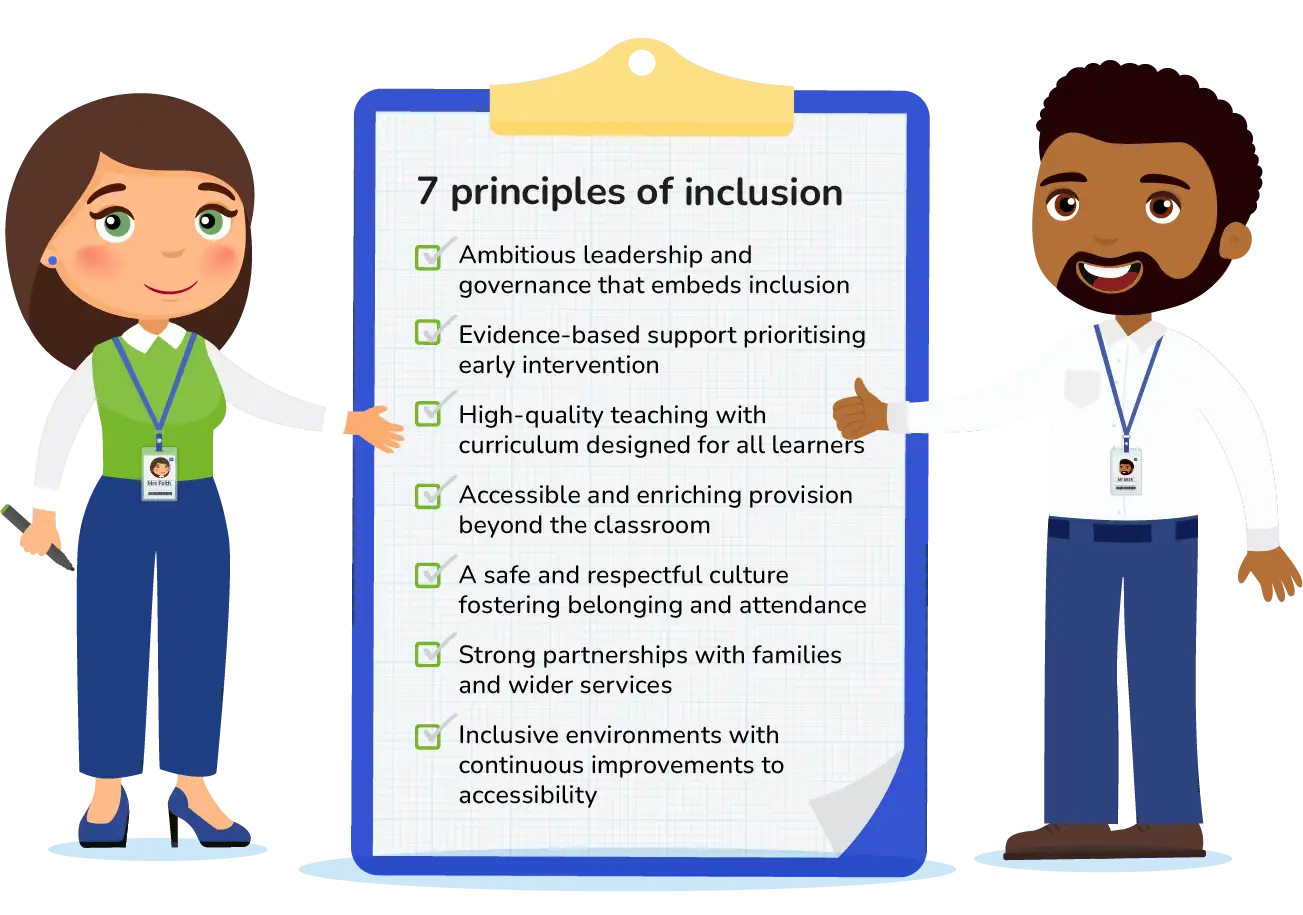
1. Ambitious leadership and governance that embeds inclusion
The Government expects inclusion to be a strategic priority that is visible throughout school leadership, decision-making and improvement planning.
Inclusive practice should be reflected in strategic planning, school improvement priorities, leadership decisions, staff development, resource allocation and day-to-day school life.
Inclusion strategy considerations
2. Evidence-based support prioritising early intervention
Schools are expected to identify needs early and provide support before difficulties become more entrenched.
Schools are expected to use assessment, observation, pupil voice and professional judgement to identify emerging needs and implement effective support as early as possible.
Inclusion strategy considerations

3. High-quality teaching with curriculum designed for all learners
High-quality teaching is the most important factor in improving outcomes for all pupils, and the curriculum should be accessible, engaging and adaptable to meet a diverse range of needs.
Through adaptive teaching, evidence-informed practice and a curriculum designed for all learners, schools can help ensure every child can participate, achieve and belong.
Inclusion strategy considerations
4. Accessible and enriching provision beyond the classroom
Children should be able to access wider school experiences, opportunities and support regardless of need or background.
Inclusion extends beyond lessons. Enrichment activities, extra-curricular opportunities, intervention provision and wider school experiences should be accessible and meaningful for all pupils.
Inclusion strategy considerations

5. A safe and respectful culture fostering belonging and attendance
Schools are expected to create environments where all children feel safe, valued, respected and able to attend, participate and thrive.
Attendance, behaviour, wellbeing and belonging are closely connected. Children are more likely to engage with learning when they feel understood, included and part of their school community.
Inclusion strategy considerations
6. Strong partnerships with families and wider services
Building meaningful partnerships with families and wider services is a key part of creating inclusive provision that reflects children’s real-life experiences and needs.
Effective partnerships can help create greater consistency between home, school and wider support networks, whilst ensuring support is informed by a fuller understanding of each child’s strengths, needs and experiences.
Inclusion strategy considerations

7. Inclusive environments with continuous improvements to accessibility
Schools are expected to review and improve physical, social and learning environments so that barriers to participation are reduced wherever possible.
Accessibility is not only about buildings. It also includes communication, learning environments, resources, routines and the wider school experience.
From December 2026, mainstream schools will be expected to publish an Inclusion Strategy setting out how they are strengthening inclusive practice and improving outcomes for children and young people.
The 7 Principles of Inclusion provide a useful framework for reviewing current provision, identifying priorities and demonstrating how inclusion is being embedded across the whole school.
For many schools, the Inclusive Mainstream Fund provides an opportunity not only to strengthen provision, but also to build a clearer, more evidence-informed approach to inclusion that can be sustained over time.